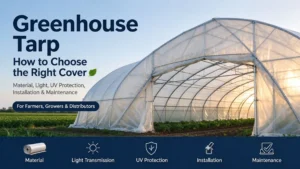
Greenhouse film may look like ordinary plastic sheeting, but in commercial agriculture it functions as part of the crop-production system. Its polymer structure, thickness, light transmission, diffusion, infrared behavior, anti-drip treatment, UV stabilization, installation quality, and chemical exposure can affect crop yield, energy use, service life, and warranty risk.
For agricultural wholesalers and distributors, the real purchase is not plastic by weight. It is a target growing environment and a defined replacement cycle.
Published estimates place the 2024 global greenhouse film market between approximately USD 5.62 billion and USD 7.59 billion, depending on product and regional definitions [TechSci Research; Grand View Research]. One forecast projects the market to reach USD 13.64 billion by 2030, representing a 10.4% compound annual growth rate [Grand View Research]. The estimates differ, but they point in the same direction: protected cultivation, high-value crops, water constraints, and demand for controlled growing conditions are expanding the category. Greenhouse Market Analysis
1. What Is Greenhouse Film and How Is It Different from Ordinary Plastic Sheeting?
Greenhouse film refers to a transparent or light-diffusing thermoplastic covering engineered for greenhouses, tunnels, and protected-cultivation structures.
The most common base materials are low-density polyethylene, linear low-density polyethylene, ethylene-vinyl acetate, modified polyolefin systems, and multilayer combinations of these polymers. Unlike construction-grade polyethylene sheeting, greenhouse film is normally formulated for continuous solar exposure and may contain UV stabilizers, infrared-retention additives, anti-drip agents, anti-fog treatments, diffusion particles, and anti-static components.
EN 13206 covers thermoplastic films used as greenhouse and tunnel covers and provides a framework for evaluating thickness, tensile properties, impact resistance, light transmission, and haze [EN 13206].
PE film based on LDPE, LLDPE, or blends of both is the largest commercial category. Typical agricultural thicknesses range from about 50 to more than 200 microns, although 100 to 200 microns is common for permanent or semi-permanent greenhouse use [EN 13206; UMass Extension]. In North America, 6 mil film, approximately 150 microns, is a familiar long-life specification. Thinner 3 mil and 4 mil products are more common in temporary tunnels or short replacement cycles [UMass Extension].
EVA film refers to PE film containing ethylene-vinyl acetate or an EVA-rich co-extruded layer. EVA can improve flexibility, low-temperature behavior, heat retention, and compatibility with anti-drip functions. Commercial EVA-based films are often supplied at 100 to 200 microns and may be rated for roughly three to five years, depending on UV stabilization, climate, chemicals, and installation [Agriculture Solutions Technical Data].
PO film is less precisely defined. In greenhouse trade, it usually describes a modified polyolefin or multilayer PE-based film designed for higher transparency, controlled diffusion, improved surface behavior, or longer durability. Buyers should request the actual resin family, layer structure, optical values, and weathering terms rather than treating “PO” as a complete technical specification.
Multilayer co-extruded film combines three, five, seven, or more functional layers. One layer may provide strength, another may carry UV stabilizers, another may contain anti-drip additives, and the outer surface may improve dust resistance. More layers allow more precise additive placement, but they do not automatically guarantee better performance.
Important indicators include PAR transmission, haze or diffusion, thermicity, tensile strength, elongation, tear resistance, dart-drop impact, thickness tolerance, anti-drip duration, and UV service period. UMass Extension reports PAR transmission of about 88% to 91% for UV-stabilized greenhouse film and around 82% to 87% for some infrared and anti-condensate films [UMass Extension]. One multilayer EVA sheet reports 88% PAR transmission, 55% diffusion, 85% thermicity, and 1,000 g dart-drop impact [Agriculture Solutions Technical Data].
Actionable recommendation: Require quotations to state polymer system, thickness, layer structure, optical values, mechanical results, UV period, anti-drip duration, intended climate, and test methods. “Clear greenhouse plastic” is not a specification.
2. Which Greenhouse Film Specifications Matter Most to Wholesalers and Distributors?
Commercial greenhouse film specifications refer to the measurable dimensions, optical properties, durability claims, packaging formats, and performance limits that determine whether a film fits a target market.
For many distributors, the most commonly traded long-life specification is approximately 150 microns or 6 mil, clear or diffused, UV stabilized, and rated for three to four years. It is not universally correct, but it often balances cost, handling, mechanical strength, and replacement frequency.
North American channels commonly offer 6 mil clear film in widths around 32 ft and lengths of 100 or 200 ft. One representative product lists about 90% light transmission, 23% diffusion, and a four-year UV warranty [Jiggly Greenhouse]. European channels often use widths such as 8 m, 10 m, 12 m, or 16 m, with roll lengths around 33 m, 50 m, or project-specific dimensions. Multilayer films between 125 and 150 microns with anti-drip, thermal, or diffusing functions are common in tunnel and greenhouse applications [DM-Folien; Kritifil Product Literature].
Clear film is the mainstream color, but clear does not always mean low haze. A high-transmission diffusing film can redistribute direct sunlight through the canopy. Diffuse white films are used where heat stress, sunscald, or uneven exposure is a concern.
Commercial high-transmission films frequently report values between 88% and 92% [UMass Extension; Jiggly Greenhouse]. Diffusion varies more widely. General-purpose films may provide around 15% to 25%, while specialized diffusing films can exceed 50% [Agriculture Solutions Technical Data]. These figures are meaningful only when the test method, thickness, and spectral range are stated.
UV periods are commonly marketed as one season, two years, three years, four years, five years, or longer. Four-year UV warranties are common in North America. European suppliers may state 27- or 33-month warranties because radiation zones, installation conditions, and chemical restrictions are included in the warranty framework [DM-Folien; Folitec]. A warranty is therefore not an unconditional promise that every installation will last the same number of years.
Regional patterns differ. Europe generally shows stronger demand for thermal, anti-condensate, multilayer, and diffusing films. North America has a large standardized 6 mil replacement market. Asian markets combine high-volume conventional PE demand with growing interest in EVA, PO, and high-diffusion films. High-radiation markets in the Middle East, Africa, and Latin America require more climate-specific selection.
I conducted a desk comparison of three public specification sets included in the research: a North American 6 mil roll, a European 150 micron film, and a multilayer EVA data sheet. The first emphasized dimensions and a four-year warranty, the second emphasized metric sizing and service terms, and the third provided detailed PAR, diffusion, thermicity, and impact values [Jiggly Greenhouse; DM-Folien; Agriculture Solutions Technical Data]. My observation was that the structure of a data sheet often reveals the supplier’s target market, while omitted values can be as important as the values displayed.
Actionable recommendation: Build a regional specification matrix covering thickness, width, length, light transmission, diffusion, UV period, anti-drip duration, warranty restrictions, greenhouse type, and target crop before deciding which rolls should be stocked.
3. How Do Light, Diffusion, Infrared Retention, and Anti-Drip Properties Affect Crops?
Greenhouse film performance refers to the way a covering changes solar radiation, internal heat loss, condensation, crop microclimate, and the energy needed to maintain growing conditions.
High light transmission is usually valuable because photosynthetically active radiation drives plant growth. However, total transmission is only one part of crop response. Direct sunlight can create hot leaf surfaces, upper-canopy saturation, and lower-canopy shading. Diffuse light redistributes radiation and can improve penetration in dense cucumber, tomato, flower, and leafy-green crops.
In a dry-climate cucumber trial, a diffusing film increased the diffuse-light fraction from 0.22 outdoors to 0.42 inside the greenhouse. Yield reached 12.3 kg/m², compared with 10.2 kg/m² under a reflecting film and 10.1 kg/m² under the control [MDPI Agronomy, 2024]. That was an advantage of roughly 20% to 22% in that specific experiment. It does not prove that every diffusing film will produce the same result, but it confirms that canopy light distribution can have measurable commercial value.
The opposite risk is excessive light blocking. In an Australian warm-greenhouse capsicum study, a light-blocking film reduced average PAR by about 27%. Cooling energy use increased by approximately 10.6% to 11.6%, and in one season red capsicum yield fell by 12.6% while orange capsicum yield fell by 25.9% [ScienceDirect Greenhouse Film Study]. Another energy-film study reported yield reductions of around 29% and 13% for two capsicum cultivars where light became limiting [Frontiers in Energy Research, 2024].
These results expose a common mistake: assuming that lowering greenhouse temperature automatically improves profitability. A film can reduce heat load and also remove the photons needed for marketable yield. Buyers should ask how selectively a film reduces near-infrared radiation while preserving PAR.
Infrared-retention or thermic films address nighttime heat loss. One covering-film study reported that an NIR-selective PE film lowered summer greenhouse air temperature by about 2°C. An IR-retaining film reduced infrared transmission by 75% and lowered winter energy use by approximately 10% [Energy Journal Greenhouse Covering Study]. The benefit can be significant in heated greenhouses, but it depends on local climate, leakage, ventilation, and the film’s visible-light performance.
Anti-drip and anti-fog treatments manage condensation. Untreated droplets can reduce light uniformity, fall onto leaves, and increase localized wetness. Anti-drip additives encourage condensation to form a thin water layer that flows toward the greenhouse edge. Their useful life may be shorter than the UV life of the base film because additives migrate, become contaminated, or lose surface activity.
For high-value crops, small changes in marketable yield, fruit uniformity, heating demand, or disease pressure can justify a more technical film. For lower-value crops or seasonal tunnels, the added cost may not be recovered. Functional additives should therefore be tied to crop economics rather than presented as universally necessary.
Actionable recommendation: Define minimum PAR, desired diffusion, heating or cooling objectives, condensation conditions, and crop value before comparing film prices. Request both initial and aged optical data when available.
4. How Should Buyers Match Greenhouse Film to Climate, Crop, and Greenhouse Design?
Film selection refers to matching material, thickness, optical behavior, thermal performance, durability, and replacement cycle to local climate, crop requirements, greenhouse structure, and operating model.
In tropical and high-radiation regions, the main risks are heat load, strong UV exposure, rapid additive depletion, and crop stress. Suitable films often combine strong UV stabilization, controlled diffusion, anti-drip performance, and adequate mechanical strength. However, excessive shading can damage high-light crops. Tomato, cucumber, and pepper projects should distinguish between useful diffusion and simple light blocking.
Arid climates may combine intense daytime radiation with large day-night temperature swings. Diffusing or selectively reflecting films can reduce hot spots and improve canopy uniformity. The cucumber trial producing 12.3 kg/m² under diffusing film supports this approach under dry, bright conditions [MDPI Agronomy, 2024]. Dust resistance, cleaning access, and abrasion also matter because dust can quickly reduce transmission.
Mediterranean climates require seasonal balance. Spring and summer production may benefit from diffusion and heat management, while cooler periods still require good transmission and thermal performance. Multilayer films around 125 to 180 microns with anti-drip, UV stabilization, and moderate diffusion are common, but actual values should follow the crop and ventilation capacity.
Temperate climates place greater emphasis on year-round light transmission, condensation control, and winter heat retention. Thermic film can reduce heating demand, but low winter radiation makes excessive absorption risky. High PAR, controlled haze, and infrared retention should be evaluated together.
Cold climates require light availability, heat conservation, and mechanical reliability. Film thickness may move toward 150 to 200 microns, but thickness alone does not guarantee wind or snow performance. Structure spacing, fastening, tension, frame protection, and double-layer inflation can matter just as much. Double-inflated plastic systems reduce heat loss by creating an insulating air space between layers [Michigan State University Extension].
Crop type changes the recommendation. Seedlings and leafy greens often benefit from uniform light and condensation control. Cucumbers and tomatoes can benefit from improved lower-canopy light distribution. Peppers require careful protection of PAR because excessive light reduction produced yield losses of 12.6% to 25.9% in one trial [ScienceDirect]. Flowers may require different spectral and quality targets from vegetables.
Greenhouse design also changes the specification. Naturally ventilated tunnels, sealed heated greenhouses, and wide-span structures create different heat, wind, tension, and abrasion risks.
More co-extruded layers do not automatically solve these issues. Three-layer structures can separate a durable outer layer, structural core, and anti-drip inner layer. Five- and seven-layer films allow more precise resin and additive placement. Yet performance still depends on resin quality, layer uniformity, formulation, extrusion control, and testing. Independent research shows that multilayer design changes mechanical and spectral behavior, but advertised features do not always produce the expected field result [Applied Sciences, 2023].
Common buying myths should be rejected. Thicker film is not always more durable. Higher transparency is not always better. UV stabilization does not automatically mean resistance to sulfur, chlorine, or pesticides. Anti-drip performance may not last for the full film life. Recycled-content film may be suitable in some applications, but consistency and weathering performance must be verified.
Actionable recommendation: Use a climate-and-crop selection form covering radiation, temperature range, heating demand, ventilation, wind, crop, pesticide program, structure, and target replacement cycle before choosing thickness or additives.
5. How Can Distributors Verify Quality and Prevent Premature Film Failure?
Greenhouse film quality control refers to the testing, traceability, storage, installation, chemical management, maintenance, and warranty evidence used to ensure that a film performs as specified.
The first step is documentation. Buyers should request a technical data sheet, batch identification, nominal and measured thickness, width tolerance, roll length, resin description, layer structure, optical methods, mechanical results, UV period, anti-drip duration, storage requirements, installation instructions, and warranty exclusions. A brochure full of icons is not a test report, despite the packaging industry’s heroic attempt to make icons look scientific.
Relevant tests include thickness, tensile strength, elongation at break, tear resistance, dart-drop impact, light transmission, haze, accelerated UV aging, and outdoor weathering. EN 13206 provides a framework for agricultural greenhouse and tunnel films [EN 13206]. Equivalent ISO, ASTM, or national methods may also be used, but the supplier should state the method, specimen direction, conditioning, thickness, and acceptance criteria.
Thickness should be measured across the film web rather than at one convenient location. Mechanical results should be reported in machine and transverse directions because film behavior differs along and across the extrusion direction. For large orders, distributors should retain a labeled sample from each batch.
Premature failure usually has several interacting causes. UV exposure consumes stabilizers and breaks polymer chains, producing yellowing, brittleness, and cracking. Sulfur-based pesticides, chlorine-containing chemicals, and concentrated agrochemical residues can accelerate degradation or invalidate warranty claims [UMass Extension; FAO]. High chemical concentrations near the roof and poor ventilation increase the risk.
Mechanical damage often starts at the structure. Sharp edges, rust, rough timber, loose fastening channels, overheated metal, and repeated flapping create localized stress. Excessive tension reduces the film’s ability to absorb movement, while insufficient tension increases abrasion. Installation under moderate temperatures is preferable because film expands and contracts with heat.
Rolls should remain dry, shaded, supported, and separated from heat, sunlight, chemicals, and sharp objects. Buyers should also confirm whether the warranty begins at manufacture, shipment, or installation.
Maintenance should include inspection of fastening points, rubbing zones, tears, deposits, and condensation behavior. Small tears should be repaired before wind enlarges them. Cleaning methods should follow the film supplier’s instructions because harsh solvents, abrasives, and high-pressure washing can damage the surface or anti-drip layer.
A practical control sequence is straightforward: confirm the application; approve the technical specification; verify batch traceability; measure thickness; review optical and mechanical reports; inspect roll dimensions and packaging; document installation date and structure condition; record chemical exposure; inspect after major wind events; retain samples for claims; plan replacement inventory; and identify recycling or recovery options before removal.
Extending a replacement cycle from two years to four years can roughly halve film-purchase frequency during that period, although labor and downtime still matter. Preventing one premature failure can protect crop value far beyond the original price difference between films.
Actionable recommendation: Treat each bulk order as a traceable quality program. Approve the specification, retain samples, document tests, control installation, record chemical exposure, and define warranty evidence before delivery.
Frequently Asked Questions
Around 150 microns, or 6 mil, is one of the most common long-life specifications. Temporary tunnels may use thinner film, while tougher conditions may justify 180 to 200 microns. Thickness must still be assessed with UV stabilization, resin quality, wind exposure, and structure design [UMass Extension].
No. “PO” is often a trade description rather than a complete polymer specification. Performance depends on the resin system, additives, layer structure, optical values, mechanical tests, and weathering record.
No. Crops need adequate PAR, but direct light can cause heat stress and uneven exposure. Diffusing film improved cucumber yield in one trial, while excessive PAR reduction caused capsicum yield losses of 12.6% to 25.9% in another [MDPI Agronomy, 2024; ScienceDirect].
Not necessarily. Anti-drip additives can migrate, become contaminated, or lose effectiveness before the UV-stabilized base film reaches the end of its service life. Request a separate anti-drip duration.
Request the technical data sheet, test methods, thickness measurements, dimensional tolerances, resin and layer description, optical and mechanical results, UV period, anti-drip duration, storage instructions, batch traceability, and written warranty terms.
Failure is often caused by a combination of UV exposure, sulfur or chlorine contamination, pesticide residues, sharp frame points, incorrect tension, wind abrasion, overheating, poor storage, and installation damage [UMass Extension; FAO].