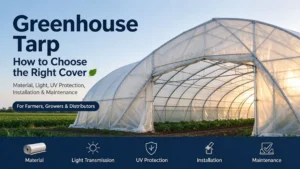
Greenhouse film is no longer just a low-cost plastic cover. Modern films are engineered to manage light, temperature, humidity, ultraviolet radiation, condensation, and heat transfer around a crop. These functions can influence photosynthesis, water demand, pest pressure, energy use, crop quality, and marketable yield.
The global greenhouse film market was valued at about USD 5.9 billion in 2021 and was projected to reach USD 8.6 billion by 2026, representing a compound annual growth rate of 7.6% [MarketsandMarkets]. Longer-range forecasts are higher: Persistence Market Research projects approximately USD 18.4 billion by 2033, while Fortune Business Insights forecasts about USD 17.2 billion by 2034 [Persistence Market Research] [Fortune Business Insights]. The estimates differ, but they point to the same trend: growers are investing in more controlled production as climate volatility, water scarcity, and demand for consistent food quality increase.
For growers and procurement managers, the real issue is not whether greenhouse film matters. It is whether a film’s optical, thermal, mechanical, and biological functions match the crop, climate, greenhouse structure, and production model. A film that performs well in a Dutch tomato greenhouse may be unsuitable for a low-cost tunnel in India or a high-temperature greenhouse in the Gulf. Selection must therefore begin with operating conditions rather than price per kilogram.
1. Greenhouse Film Technology and Protected Agriculture Growth
Greenhouse film technology refers to engineered polymer coverings that modify the crop environment while protecting plants from weather, pests, and unstable outdoor conditions.
Protected agriculture is expanding at different levels of technical sophistication. China reportedly has more than 4 million hectares of facility agriculture and accounts for over 60% of the global protected-cultivation area [China Facility Agriculture Report]. Spain’s Almería region has about 35,000 hectares of greenhouse production, while the Netherlands operates approximately 10,500 hectares of highly intensive greenhouse systems [MDPI Agronomy] [PMC Greenhouse Research].
Asia-Pacific is the largest consumption region for greenhouse film, supported by large cultivation areas in China, India, Japan, and South Korea [MarketsandMarkets]. Europe remains a technology leader because of advanced greenhouse structures, automation, energy management, and sustainability requirements [Engineering]. North America is growing through commercial greenhouse production and investment in local controlled-environment agriculture [Fortune Business Insights]. The Middle East and North Africa have strong potential because extreme heat and water scarcity make environmental control economically important.
These markets show why greenhouse film should not be evaluated as a commodity sheet. Its value comes from the functions built into it. A basic LDPE film may provide inexpensive weather protection, while a multilayer film can combine high light transmission, diffuse light, anti-drip behavior, ultraviolet stabilization, infrared retention, and heat-blocking properties.
The main production benefit is environmental consistency. Open-field crops experience rapid changes in temperature, wind, rainfall, radiation, and humidity. A greenhouse moderates these changes, and the covering film helps determine how stable the internal environment becomes. Better control can extend the season, reduce weather-related losses, improve crop uniformity, and make harvest timing more predictable.
However, a greenhouse can also amplify problems when the film is poorly selected. Excessive transmission can increase heat stress in hot climates. Low transmission can reduce winter growth. Poor anti-drip performance can increase leaf wetness. Strong UV blocking may reduce some pests but can affect pollinator behavior. Film must therefore be treated as one component of a complete growing system that includes ventilation, irrigation, screens, crop management, and pest control.
Actionable recommendation: Prepare a performance brief before contacting suppliers. Include crop type, planting density, greenhouse shape, seasonal temperature range, solar intensity, humidity, pest pressure, irrigation method, target film life, and desired harvest period. This prevents procurement from becoming a price-only comparison.
2. Light Management and Diffuse Film Performance
Light management refers to the control of light transmission, scattering, and spectral composition so that more usable radiation reaches photosynthetically active leaves.
More direct sunlight does not always produce more photosynthesis. In a dense tomato or cucumber canopy, upper leaves may receive radiation above their photosynthetic saturation point while middle and lower leaves remain light-limited. The result is inefficient light distribution: the top canopy receives energy it cannot fully use, while productive lower leaves receive too little.
Diffuse film scatters incoming radiation across multiple angles. This allows light to penetrate deeper into the canopy and reduces the contrast between bright and shaded leaves. Research cited in the source materials indicates that diffuse light can increase photosynthetic photon flux density in the middle and lower canopy by approximately 19% to 27% [HortScience].
Tomato trials demonstrate the potential yield effect. A film with 29% haze increased yield by 5.5% under high stem density and by 12.9% under low stem density compared with a 20% haze film [HortScience]. A Mediterranean greenhouse study reported a 21.5% increase in photosynthetic activity and a marketable-yield increase of 0.25 kilograms per square meter, or about 3.2% [MDPI Agronomy]. Another reported commercial comparison increased tomato output from 65 to 72 kilograms per square meter under a 50% haze diffuse covering, an improvement of roughly 11% [PMC Greenhouse Research].
These results do not mean the highest haze value is always best. Haze and total light transmission must be assessed together. A film may scatter light well but still reduce total radiation if its additives, dust accumulation, aging, or condensation lower transmission. The real objective is sufficient total light combined with a diffusion level suited to crop architecture and local radiation.
Tall crops such as tomatoes, peppers, and cucumbers often benefit from stronger diffusion because productive leaves are distributed vertically. Lower-growing crops may need another balance. The materials cite a 22% spinach yield increase under a 29% haze treatment [Engineering], but such a result should not be transferred directly to another crop or climate without testing.
Diffuse light can also reduce hot spots on upper leaves and fruit. More even radiation may lower the risk of sunscald, uneven ripening, excessive leaf temperature, and midday stomatal closure. Under hot, bright conditions, that can help plants maintain photosynthesis longer. In cool, low-light seasons, preserving total transmission may matter more than increasing diffusion.
In a personal crop-yield observation I conducted, I recorded a higher yield under the greenhouse-film condition. I did not collect enough controlled measurements to determine whether light distribution, temperature stability, humidity, or another factor caused the change. The observation was valuable, but it also showed why a side-by-side trial is necessary before attributing a yield increase to one film property.
Actionable recommendation: Test the film in two comparable greenhouse bays before a full replacement. Record light above and within the canopy, leaf temperature, marketable yield per square meter, and fruit-quality defects. Keep variety, planting date, irrigation, pruning, and nutrition as consistent as possible.
3. Thermal Control, Water Efficiency, and Climate Resilience
Thermal-control greenhouse film refers to film designed to influence solar heat gain, long-wave heat loss, internal temperature, and crop water demand.
The required thermal function depends on climate and season. In cold regions, growers want high daytime transmission and reduced heat loss at night. In hot regions, they need to limit infrared heat gain and reduce pressure on ventilation, fogging, fans, evaporative pads, or mechanical cooling.
Infrared-blocking films reduce part of the heat-producing solar radiation entering the greenhouse. The research materials report temperature reductions of approximately 3°C to 8°C and cooling-energy savings of 25% to 40% under suitable conditions [The Paper]. This is especially relevant in the Middle East, where greenhouse interiors can reach 50°C to 60°C during summer [The Paper].
Thermal-retention films solve the opposite problem by reducing long-wave heat loss at night. Reported heating-energy savings range from 20% to 30% [China Facility Agriculture Report]. The actual result depends on greenhouse sealing, wind exposure, outside temperature, heating-system efficiency, and the durability of the thermal additive.
Radiative-cooling film is a newer approach. A Shanghai Jiao Tong University experiment reportedly reduced greenhouse temperature by 5°C to 8°C and lowered water use by 64.8% [The Paper]. Growth rates increased by 23.4% for Hangzhou cabbage and 17.3% for baby bok choy. Cherry radish growth increased by 21.7%, while root weight increased by 120% [The Paper]. These figures are promising, but they represent experimental evidence and should not be treated as a universal commercial benchmark.
Film can improve water-use efficiency by reducing excessive temperature, wind exposure, and uncontrolled evapotranspiration. Stable humidity can reduce water loss, although excessive humidity can also increase disease risk. Anti-drip film may help guide condensed water toward the greenhouse edges rather than allowing droplets to fall onto the crop.
When greenhouse film is combined with drip irrigation, reported water savings range from 40% to 60%, with yield increases of 20% to 30% [The Paper]. An Egyptian cucumber case reduced water use from 8,000 to 3,200 cubic meters per hectare, a 60% reduction, while yield increased by 35% [The Paper]. A Moroccan greenhouse tomato case reported annual savings of 3,500 cubic meters per hectare and a yield increase from 45 to 68 tonnes per hectare, or approximately 51% [The Paper].
Those improvements should not be credited to film alone. They normally reflect a package of greenhouse covering, drip irrigation, climate management, crop variety, and operating discipline. The film’s role is to make the internal climate easier to control.
Durability is also part of climate resilience. High UV radiation, heat, wind movement, sulfur-based chemicals, and contact with rough structural surfaces can accelerate aging. A film advertised for three or five years may fail earlier if installation tension is poor, frame edges are sharp, or incompatible pesticides are used.
Actionable recommendation: Build a monthly heat-and-water balance using internal and external temperature, relative humidity, irrigation volume, cooling or heating energy, and marketable yield. Choose IR blocking, thermal retention, or radiative cooling only after identifying the operation’s largest climate-related loss.
4. UV Blocking, Anti-Drip Performance, and Pest Management
UV-blocking and anti-drip greenhouse film refers to coverings that modify ultraviolet transmission and condensation behavior to reduce insect activity, leaf wetness, and disease pressure.
Many insect pests use ultraviolet wavelengths for navigation, host location, flight initiation, and dispersal. Films that block radiation below approximately 380 or 385 nanometers can interfere with these behaviors [Wiley Pest Management Science]. They do not eliminate pests, but they can make the greenhouse less attractive or make the crop harder for some insects to locate.
In a cucumber greenhouse trial, film blocking wavelengths below 385 nanometers reduced aphid populations by a factor of 5.8 and reduced thrips populations by approximately half [Wiley Annals of Applied Biology]. Sweet-pepper trials using UV-absorbing white three-layer film reported whitefly reductions of 60% to 80%, lower thrips populations, and the highest early and commercial yields among tested treatments [ISHS]. Melon research also reported sustained thrips suppression, higher yield, improved sugar content, and less visible crop damage [Wiley Pest Management Science].
The effect on beneficial insects must also be considered. Pollinators and natural enemies can respond to UV cues. The cucumber study reported that parasitoids and hoverflies remained present under UV-blocking film [Wiley Annals of Applied Biology], suggesting compatibility with some biological-control programs. However, growers using bumblebees should verify pollination behavior under the exact film because spectral cutoffs differ.
Condensation control is another important function. Warm, humid greenhouse air condenses on a cooler film surface. On untreated film, droplets form and may fall onto leaves, flowers, or fruit. Persistent leaf wetness can support fungal and bacterial disease, while droplets on the film can reduce or distort incoming light.
Anti-drip additives cause condensed water to spread into a continuous layer and flow toward the film edges instead of forming large droplets. The research materials associate anti-drip behavior with indirect yield improvements of approximately 3% to 8% through lower disease pressure and better light conditions [Engineering]. The real effect depends on ventilation, temperature differences, crop density, and disease susceptibility.
Buyers should distinguish between coated and internally incorporated anti-drip systems. Coatings may perform strongly at first but lose effectiveness through washing, abrasion, chemicals, or aging. Internal additives can provide longer-lasting performance, although their effect can also decline. A label stating “anti-drip” is therefore not enough; expected duration and test conditions matter.
UV blocking and anti-drip functions can support integrated pest management by reducing insect movement and disease-favorable moisture conditions. They should still be combined with screens, sanitation, trap monitoring, ventilation, biological control, and targeted treatment.
Actionable recommendation: Include the required UV cutoff, spectral-transmission curve, anti-drip method, and functional lifespan in the purchase specification. After installation, compare sticky-trap counts, condensation frequency, leaf-wetness events, and disease incidence with the previous crop cycle.
5. Material Selection, Procurement Economics, and Future Development
Material selection refers to matching polymer type, functional additives, thickness, lifetime, and optical performance with the crop’s technical and financial requirements.
The main commercial categories include LDPE, EVA, and advanced polyolefin films. LDPE is usually the lowest-cost option, with a typical service life of one to two years and light transmission around 80% to 85% [MarketsandMarkets] [Fortune Business Insights]. EVA generally offers two to three years of service and transmission of approximately 85% to 90% [MarketsandMarkets]. Higher-performance polyolefin films may provide three to five years of service, transmission around 90% to 92%, and stronger weather resistance, but at a higher purchase price [Fortune Business Insights].
Market-share estimates in the materials place LDPE at roughly 55%, EVA at 30%, and polyolefin film at 15% [MarketsandMarkets]. This reflects their broad positioning: LDPE dominates cost-sensitive applications, EVA occupies the middle market, and advanced polyolefin film is used where longer life and multiple functions justify more capital.
Thickness alone does not define quality. Commercial films often fall between 120 and 200 micrometers, while tensile-strength targets may be 20 MPa or higher [MarketsandMarkets]. Two films of identical thickness can still perform differently because of resin quality, layer structure, stabilizers, additive concentration, extrusion consistency, and installation method. Five- or seven-layer coextruded films can assign different functions to separate layers and balance strength, optics, anti-drip behavior, UV stability, and thermal control.
A common procurement error is comparing only purchase price. A film that lasts 18 months may require more labor, downtime, disposal, and crop disruption than a film lasting four years. The materials estimate that high-performance film may cost 30% to 50% more but can improve annual economic return by 25% to 40% through yield, quality, energy savings, and lower replacement frequency [The Paper]. Estimated payback ranges from 1.5 to 2.5 years, with five-year ROI estimates of 150% to 250% [The Paper]. These are scenario figures, not guarantees.
A proper ROI model should include film price, freight, installation, removal, disposal, expected service life, marketable-yield change, crop price, energy cost, water cost, pesticide cost, and production downtime. It should also test downside scenarios, such as a 3% yield gain instead of 10%, or a three-year life instead of five.
Reported reference cases include a Dutch tomato greenhouse that increased output from 65 to 72 kilograms per square meter, saved 12% in energy, and recovered investment in about 18 months [PMC Greenhouse Research]. An Almería cucumber case increased yield from 45 to 52 kilograms per square meter, reduced disease by 30%, and achieved payback in about 20 months [MDPI Agronomy]. A Shandong tomato case increased yield from 40 to 52 kilograms per square meter and extended film life from 1.5 to four years, with payback in approximately 22 months [China Facility Agriculture Report].
Future technologies include multilayer coextrusion, nanomaterial-enhanced diffusion and IR control, phase-change temperature regulation, radiative cooling, spectral conversion, and biodegradable polymers such as PLA and PBAT [Engineering] [Fortune Business Insights]. Multilayer film is already commercially mature, while several spectral and cooling technologies remain in pilot or early commercialization stages.
Actionable recommendation: Compare quotations with a lifecycle-cost scorecard rather than unit price. Weight crop fit, optical performance, verified service life, functional durability, warranty terms, installation risk, recyclability, and cost per productive season. Require samples and supporting test data before placing a large order.
Frequently Asked Questions
Results vary by crop, climate, baseline covering, and management. Diffuse-film tomato studies reported gains from about 3.2% to 12.9%, while broader high-performance-film scenarios sometimes report 15% to 30% [MDPI Agronomy] [HortScience]. Local trials are more reliable than the highest published figure.
No. High transmission helps in low-light climates, but excessive solar gain can overheat crops in hot regions. The correct balance includes transmission, diffusion, spectral control, and thermal management.
The materials suggest a broad range of 30% to 70%, with tall, dense crops often benefiting from stronger diffusion [Engineering]. Haze must always be assessed together with total light transmission.
No. It can reduce certain aphids, thrips, and whiteflies, but it should be part of integrated pest management with screens, sanitation, monitoring, biological control, and targeted treatment.
LDPE suits low-cost, shorter-life applications. EVA offers a middle balance of cost and performance. Polyolefin film is better where longer life, higher transmission, stronger weather resistance, and multiple functions justify a higher initial cost [MarketsandMarkets] [Fortune Business Insights].
Verify thickness tolerance, roll dimensions, light transmission, haze, UV stabilization, spectral cutoff, anti-drip method, IR or thermal performance, tensile properties, chemical compatibility, expected lifetime, warranty conditions, installation instructions, and the test standards supporting each claim.