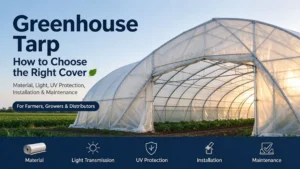
Greenhouse films have evolved from basic plastic coverings into engineered agricultural materials that influence crop temperature, light distribution, moisture control, disease pressure, and production consistency. This transformation is occurring while growers face more volatile weather, tighter water availability, limited arable land, rising food demand, and stronger pressure to reduce agricultural waste. What is a greenhouse?
Market forecasts differ considerably because research firms use different product definitions. Some reports count only greenhouse covering films, while others include tunnel films, specialized agricultural sheets, or adjacent protected-cultivation materials. Nevertheless, most available forecasts point in the same direction: global demand is expanding, functional films are gaining importance, and buyers are becoming more concerned with lifecycle performance rather than initial purchase price alone.
1. Global Greenhouse Film Market Size and Long-Term Growth
The global greenhouse film market refers to the worldwide commercial demand for polymer films used as protective and environmental-control coverings in greenhouses, high tunnels, low tunnels, nurseries, and other protected agricultural structures.
Research estimates place the 2025 global greenhouse film market at approximately USD 9 billion to USD 10.7 billion, depending on the scope and methodology used. Research Nester estimates a market value of approximately USD 9.2 billion in 2025 and forecasts that it may reach about USD 23.9 billion by 2035, representing a compound annual growth rate of approximately 11.2% from 2026 to 2035 [Research Nester].
A separate Research Nester forecast estimates that the market was worth about USD 9.93 billion in 2024, could reach USD 10.68 billion in 2025, and may exceed USD 32.31 billion by 2037, with a projected CAGR of approximately 9.5% [Research Nester]. Although the two forecasts differ, both suggest that greenhouse films will substantially outpace the growth of many conventional agricultural input categories.
Fortune Business Insights provides a more conservative but still positive outlook. Its forecast indicates that the greenhouse film market could grow from approximately USD 8.77 billion in 2026 to USD 17.2 billion by 2034, corresponding to a CAGR of about 8.78% [Fortune Business Insights]. Global Insight Services presents an even more conservative estimate, projecting growth from approximately USD 4.8 billion in 2024 to USD 8.2 billion in 2034, at a CAGR of around 5.5% [Global Insight Services].
These variations should not be treated as evidence that one forecast is necessarily incorrect. The differences usually result from varying definitions of greenhouse film, regional data coverage, price assumptions, and the inclusion or exclusion of specialized film categories. A realistic industry interpretation is that the market is likely to maintain medium-to-high single-digit annual growth, with premium functional films growing faster than standard commodity-grade coverings.
The broader agricultural films market provides useful context. Fortune Business Insights estimated the global agricultural films market at approximately USD 12.72 billion in 2025 and projected growth from USD 13.55 billion in 2026 to USD 21.75 billion by 2034, representing a CAGR of about 6.0% [Fortune Business Insights]. This comparison indicates that greenhouse films may grow faster than the overall agricultural film industry because protected cultivation requires more specialized performance.
Historically, market growth has been supported by the expansion of greenhouse vegetable cultivation, flower production, seedling nurseries, high-value fruit farming, and controlled-environment agriculture. Greenhouse films are no longer purchased only as replacement sheets. In many markets, they are selected as components of production systems designed around target crops, local temperatures, solar radiation, rainfall, humidity, and expected service life.
Asia-Pacific is widely identified as the largest and one of the fastest-growing regional markets. China and India are especially important because of their large agricultural sectors, substantial food demand, expanding protected cultivation, and investment in agricultural modernization [Research Nester]. Europe and North America remain significant markets for higher-specification films, although growth tends to be more closely associated with replacement cycles, energy efficiency, and technological upgrades than with rapid expansion of cultivated area.
The market therefore has two parallel growth engines. Emerging agricultural markets are increasing the total area under protected cultivation, while mature greenhouse markets are upgrading from basic films to multilayer, thermal, anti-drip, anti-fog, UV-stabilized, and light-diffusing materials.
Actionable recommendation: Market participants should not rely on a single headline market-size forecast. They should build regional demand models using greenhouse area, replacement frequency, average film lifespan, film thickness, climate requirements, and the share of standard versus functional films.
2. Agricultural Applications and Regional Demand Hotspots
Greenhouse film applications refer to the crop-production scenarios in which plastic covering materials are used to protect plants, modify growing conditions, extend seasons, and improve the reliability of agricultural output.
The global agricultural plastic film industry includes greenhouse films, mulch films, silage films, tunnel films, and several specialized agricultural coverings. Among these categories, mulch films generally represent the largest volume because they are widely applied directly to soil in open-field farming. Greenhouse films, however, generally occupy a higher-value position because they require more demanding optical, mechanical, and thermal properties.
MarketsandMarkets classifies agricultural films by materials such as low-density polyethylene, linear low-density polyethylene, ethylene-vinyl acetate, high-density polyethylene, recycled materials, and other polymer formulations. Major applications include greenhouse covering, small tunnels, mulching, and silage storage [MarketsandMarkets / GII].
Available industry structures suggest that greenhouse films may account for roughly 25% to 35% of agricultural film value, while mulch films may represent approximately 35% to 45%. Silage films may account for roughly 10% to 20%, with other agricultural films representing the remaining share. These figures should be treated as indicative ranges rather than audited market shares because the underlying reports use different category definitions [MarketsandMarkets / GII; Fortune Business Insights].
Within greenhouse agriculture, demand comes from several distinct applications. Vegetable greenhouses require films that support light transmission, temperature management, and condensation control. Flower and ornamental nurseries may prioritize light diffusion and uniform crop appearance. Seedling production often requires tighter control of humidity, temperature, and disease pressure. High tunnels used for berries and export vegetables may emphasize UV resistance, mechanical strength, and seasonal extension.
Regional growth is closely related to agricultural constraints and commercial crop opportunities.
China remains a major market because of its extensive use of plastic-covered greenhouses and tunnels for vegetables, fruits, and nursery production. Demand increasingly includes upgraded films with longer service life and multiple functions rather than only low-cost single-layer coverings [Research Nester].
India is another important growth market. Government-supported protected cultivation, polyhouse development, drip irrigation, and high-value horticulture have increased the use of greenhouse and tunnel films. The Indian market is highly diverse, ranging from basic seasonal structures to more advanced controlled-production projects.
Mexico has developed a strong protected-agriculture sector serving domestic and export markets. Tomatoes, peppers, cucumbers, berries, and other high-value crops are frequently grown in greenhouses or high tunnels. Export-oriented production creates demand for consistent quality, longer operating seasons, and more predictable yields [MarketsandMarkets / GII].
Saudi Arabia and the United Arab Emirates represent a different demand profile. Their growth is driven less by conventional agricultural expansion and more by food-security strategies, water scarcity, extreme heat, and investment in controlled-environment agriculture. These conditions increase interest in films that manage solar radiation, reduce heat accumulation, improve light diffusion, and withstand intense ultraviolet exposure.
African markets currently have smaller commercial volumes, but some countries offer substantial long-term potential. Greenhouse and irrigation projects are increasingly connected to urban food supply, horticultural exports, youth agriculture programs, and international development initiatives. However, market growth may be uneven because financing, logistics, technical support, and replacement-film availability remain significant constraints.
Europe and North America continue to support demand for high-performance greenhouse films. In these regions, replacement decisions are often based on energy efficiency, condensation management, crop quality, labor efficiency, environmental compliance, and compatibility with increasingly sophisticated greenhouse systems.
Regional demand therefore cannot be understood through total agricultural area alone. High-value crop intensity, weather risks, export orientation, water availability, local greenhouse design, and the maturity of agricultural distribution networks are equally important.
Actionable recommendation: Before entering a regional greenhouse film market, buyers and distributors should create a climate-and-crop specification matrix covering UV exposure, temperature range, humidity, wind load, rainfall, crop sensitivity, expected lifespan, and installation method.
3. Structural Drivers Behind Rising Greenhouse Film Demand
Greenhouse film demand refers to the quantity and performance level of agricultural covering materials required as growers respond to climate volatility, food-security pressure, resource limitations, and the need for year-round production.
Climate change is one of the most important structural drivers. Extreme heat, irregular rainfall, drought, storms, and unexpected temperature changes make open-field production less predictable. Greenhouse films cannot eliminate these risks, but they can reduce direct crop exposure and provide a more manageable production environment.
This risk-reduction function is increasingly valuable for high-value crops. A failed harvest of tomatoes, peppers, berries, flowers, seedlings, or specialty vegetables can represent a much larger financial loss than the cost of the greenhouse covering itself. As a result, film selection is becoming part of production-risk management rather than a simple packaging-material decision.
Population growth adds further pressure. The global population is projected to approach approximately 9.7 billion by 2050, increasing long-term demand for food, agricultural productivity, and more reliable supply systems [United Nations]. Urbanization also changes consumption patterns by increasing demand for fresh vegetables, fruits, and year-round product availability.
At the same time, the amount of suitable agricultural land cannot expand indefinitely. Soil degradation, urban development, salinity, erosion, and competing land uses restrict the ability to increase food supply by simply cultivating more land. Protected agriculture offers a way to raise output per unit of land, particularly for high-value crops.
Water scarcity is another major factor. Greenhouses are often used with drip irrigation, fertigation, soil covers, and environmental monitoring. This integrated approach can improve water-use efficiency compared with poorly managed open-field production. The effect is especially important in the Middle East, North Africa, parts of India, northern China, Mexico, and other water-stressed regions.
Year-round production is also a commercial driver. Retailers, food processors, exporters, and urban wholesale markets prefer stable supply schedules. Greenhouse cultivation can extend growing seasons, reduce gaps in production, and improve consistency. Films with thermal properties can help retain heat in cooler periods, while light-diffusing or heat-management films can reduce crop stress in high-radiation regions.
Controlled-environment agriculture is increasing the performance expected from covering materials. A greenhouse film must interact with ventilation, irrigation, heating, cooling, shading, crop type, and pest-management practices. A film with very high light transmission may be desirable in one climate but may cause excessive heat or crop stress in another. Similarly, strong thermal retention may reduce heating costs in cold regions but provide little benefit in hot climates.
Condensation management illustrates this relationship. Water droplets forming on the inside surface of a greenhouse film can reduce light transmission and may drip onto crops, potentially contributing to disease conditions. Anti-drip and anti-fog treatments are therefore not cosmetic features; they influence light availability, crop moisture, and greenhouse hygiene.
During my review of the available market forecasts and technical summaries, I compared the claims made by multiple research organizations rather than relying on the highest growth estimate. I observed that the strongest recurring signal was not any single market-size figure. It was the consistent movement toward films selected for climate adaptation, crop performance, and longer replacement cycles. That comparison was a real research observation from the preparation of this article, not a fabricated field experiment.
The economic logic of greenhouse films is consequently shifting from initial price toward total operating value. A cheaper film may create higher costs if it fails early, loses optical performance, develops excessive condensation, tears during installation, or does not match the local climate. Conversely, a more expensive film does not automatically produce better results if its functions are unnecessary or poorly matched to the greenhouse.
Actionable recommendation: Growers and project planners should evaluate greenhouse film through total lifecycle cost, including purchase price, installation labor, replacement frequency, crop-loss risk, energy effects, optical performance, and disposal cost.
4. PE, EVA, PO, and Multilayer Greenhouse Film Technology Trends
Greenhouse film technology refers to the combination of polymer materials, multilayer structures, additives, surface treatments, and manufacturing processes used to control durability, light, heat, condensation, and mechanical performance.
Polyethylene remains the dominant material platform because it offers a practical balance of cost, flexibility, processability, and availability. Low-density polyethylene and linear low-density polyethylene are widely used in agricultural films, often in blended formulations designed to improve strength and flexibility [MarketsandMarkets / GII].
Basic PE films provide physical protection and light transmission, but their service life and environmental-control capabilities depend heavily on resin quality, film thickness, UV stabilizers, manufacturing consistency, and local exposure conditions. Two films with the same nominal thickness can perform differently if their polymer composition and additive systems are not equivalent.
EVA-enhanced films incorporate ethylene-vinyl acetate to modify flexibility, light transmission, impact resistance, and thermal behavior. EVA can improve certain performance characteristics, particularly in colder conditions, but the appropriate formulation depends on climate, crop, and greenhouse structure.
PO films are commonly positioned as higher-performance greenhouse coverings. In industry usage, the term often refers to polyolefin-based multilayer films engineered with advanced additives and coatings. PO films may offer strong transparency, durability, anti-drip performance, and resistance to degradation, although performance varies by formulation and manufacturing quality.
One of the clearest technology trends is the expansion of multilayer co-extrusion. Three-layer and five-layer structures allow manufacturers to assign different functions to different parts of the film. An outer layer may be designed for UV and weather resistance, a core layer for mechanical strength or thermal performance, and an inner layer for anti-drip or anti-fog behavior.
Five-layer and more complex structures offer greater formulation flexibility, but additional layers do not automatically guarantee better agricultural performance. Layer quality, raw-material compatibility, additive migration, thickness uniformity, and production control remain critical. A poorly manufactured five-layer film may perform worse than a well-designed three-layer film.
UV stabilization is essential because prolonged solar exposure degrades polymers. However, expected film life cannot be defined by a universal number of months or years. UV intensity, altitude, temperature, greenhouse orientation, chemical exposure, installation tension, and contact with metal structures all influence durability.
Light diffusion is another important trend. Rather than allowing sunlight to enter only as direct beams, diffusing films scatter light more evenly through the crop canopy. This can reduce localized crop stress and improve lower-leaf exposure. The ideal diffusion level depends on crop type and climate; extremely high diffusion is not automatically beneficial in low-light regions.
Thermal films are designed to reduce infrared heat loss, particularly at night. Their economic value is strongest in climates where heating costs are significant. In hot climates, solar-management and cooling-related properties may be more important than thermal retention.
Anti-drip and anti-fog functions are also becoming more common. These properties aim to spread condensation into a thin water layer rather than allowing droplets to form. Their effectiveness can decline over time because additives may migrate, surfaces may become contaminated, or installation conditions may differ from laboratory testing.
The next stage of greenhouse film development will likely involve greater crop and climate customization. Rather than marketing one universal premium film, manufacturers and agricultural specialists are moving toward combinations of UV control, light diffusion, thermal retention, anti-drip behavior, mechanical strength, and expected lifespan.
Sustainability will also shape future technology. Recycled content, improved recyclability, downgauging, collection systems, and extended service life may reduce environmental impact. However, incorporating recycled materials into high-performance greenhouse films can be technically difficult because optical clarity, contamination, mechanical consistency, and additive compatibility must be controlled.
Biodegradable films are advancing more rapidly in mulch applications than in long-life greenhouse coverings. Greenhouse films must survive prolonged sunlight, wind, tension, temperature changes, and repeated agricultural operations. Materials designed to biodegrade may struggle to provide the required combination of durability, transparency, strength, and cost. Traditional PE-based films are therefore unlikely to be fully replaced in the near term.
Actionable recommendation: Film specifications should define required agricultural outcomes—such as target lifespan, diffusion level, condensation control, thermal behavior, and UV environment—instead of selecting materials solely by labels such as PE, EVA, PO, three-layer, or five-layer.
5. Procurement Priorities, Industry Risks, and the Outlook to 2030
Greenhouse film procurement refers to the structured process of selecting films and suppliers according to technical suitability, lifecycle economics, quality consistency, delivery capability, compliance, and project risk.
Professional agricultural distributors and greenhouse project buyers increasingly evaluate more than price and thickness. Important criteria include expected service life, raw-material quality, UV stabilization, mechanical strength, light transmission, diffusion, anti-drip performance, roll dimensions, thickness tolerance, customization, minimum order quantity, certification, packaging, delivery time, and supplier reliability.
One common purchasing mistake is to assume that greater thickness always means longer life. Thickness contributes to mechanical strength and durability, but it cannot compensate for poor resin selection, inadequate UV stabilization, weak manufacturing control, or unsuitable installation.
Another mistake is treating lifespan claims as universally transferable. A film described as suitable for three or five years may not achieve the same lifespan in every country. Solar radiation, altitude, heat, chemical exposure, wind, greenhouse structure, and maintenance practices can substantially alter actual performance.
Price-only purchasing also creates hidden risk. A lower-cost film may have inconsistent thickness, weaker rolls, lower UV resistance, unstable additives, or inadequate batch control. However, the opposite assumption is equally flawed: a high price does not prove that a film is technically suitable. Procurement should be evidence-based rather than brand- or price-based.
Buyers should request clear technical specifications. These may include nominal thickness, allowable thickness variation, tensile properties, elongation, tear strength, dart impact, light transmission, haze or diffusion, thermal characteristics, anti-drip expectations, UV stabilization, roll width, roll length, weight tolerance, and storage guidance.
Sampling and pilot installation are especially valuable for large projects or unfamiliar climates. A controlled trial cannot perfectly reproduce several years of exposure, but it can reveal installation behavior, roll consistency, film clarity, early condensation performance, packaging quality, and compatibility with the greenhouse structure.
Supplier capability should also be evaluated. Relevant factors include production equipment, co-extrusion capability, raw-material traceability, testing methods, batch records, quality-management procedures, complaint handling, export packaging, and the ability to maintain consistent formulations across repeat orders.
Raw-material price volatility remains a major industry challenge. Polyethylene and related polymers are linked to petrochemical markets, energy costs, plant operating rates, freight conditions, and regional supply balances. Sudden movements can affect quotations, margins, inventory decisions, and contract reliability.
Environmental regulation is another growing concern. Agricultural plastics can become contaminated with soil, crop residues, chemicals, and moisture, making collection and recycling difficult. Europe and other regions are increasing regulatory pressure on plastic waste, recycling, product design, and producer responsibility. These changes may raise compliance and disposal costs while encouraging films that are easier to collect or recycle.
Supply-chain risk also remains relevant. Freight disruption, port congestion, geopolitical tension, exchange-rate movement, and resin shortages can delay seasonal agricultural projects. A film arriving after the installation window may have limited value, even when its technical quality is acceptable.
From 2025 to 2030, procurement trends are likely to include greater OEM customization, private labeling, regional stocking, shorter lead times, smaller trial orders, functional-film portfolios, and closer coordination between film suppliers, greenhouse builders, agronomists, and irrigation specialists.
Agricultural distributors may also segment their portfolios more carefully. Instead of selling one generic greenhouse film, they may offer separate options for high-UV climates, cold regions, humid crops, high tunnels, nursery use, export vegetables, short seasonal cycles, and long-term commercial greenhouses.
Sustainability claims will require stronger evidence. Buyers should distinguish among biodegradable materials, recycled content, recyclable design, extended service life, reduced thickness, and take-back systems. These concepts are not interchangeable. A film with a longer usable life may reduce replacement frequency, but it still requires proper end-of-life management.
The most credible procurement strategy is therefore a balance of technical suitability, cost control, supplier verification, logistics planning, and environmental responsibility.
Actionable recommendation: Buyers should implement a formal supplier scorecard covering technical compliance, test documentation, batch consistency, delivered cost, lead-time reliability, complaint response, packaging quality, recyclability considerations, and performance under local conditions.
Frequently Asked Questions
Available estimates generally place the 2025 market between approximately USD 9 billion and USD 10.7 billion. Research Nester estimates approximately USD 9.2 billion to USD 10.68 billion, depending on the forecast edition and market definition [Research Nester].
Asia-Pacific is generally identified as the largest regional market, supported by extensive protected cultivation, large agricultural populations, growing food demand, and continued investment in agricultural modernization in countries such as China and India [Research Nester; Fortune Business Insights].
No. PO films are often designed as higher-performance multilayer products, but suitability depends on formulation, climate, crop, installation, expected lifespan, and quality control. A well-designed PE or EVA film may be more appropriate than an incorrectly specified PO film.
Full replacement is unlikely in the near term. Biodegradable films are developing more rapidly in short-life mulch applications. Greenhouse coverings require long-term strength, transparency, UV resistance, and weather durability, which remain difficult to combine with controlled biodegradation at a competitive cost.
The most common mistake is selecting only by price or nominal thickness. Professional procurement should also evaluate resin quality, UV stabilization, optical properties, mechanical performance, climate suitability, lifespan assumptions, batch consistency, and supplier reliability.
A buyer should specify the greenhouse location, crop, structure type, film width and length, target thickness, expected lifespan, UV conditions, temperature range, required anti-drip or anti-fog performance, light-diffusion needs, thermal requirements, order quantity, packaging, and delivery schedule.